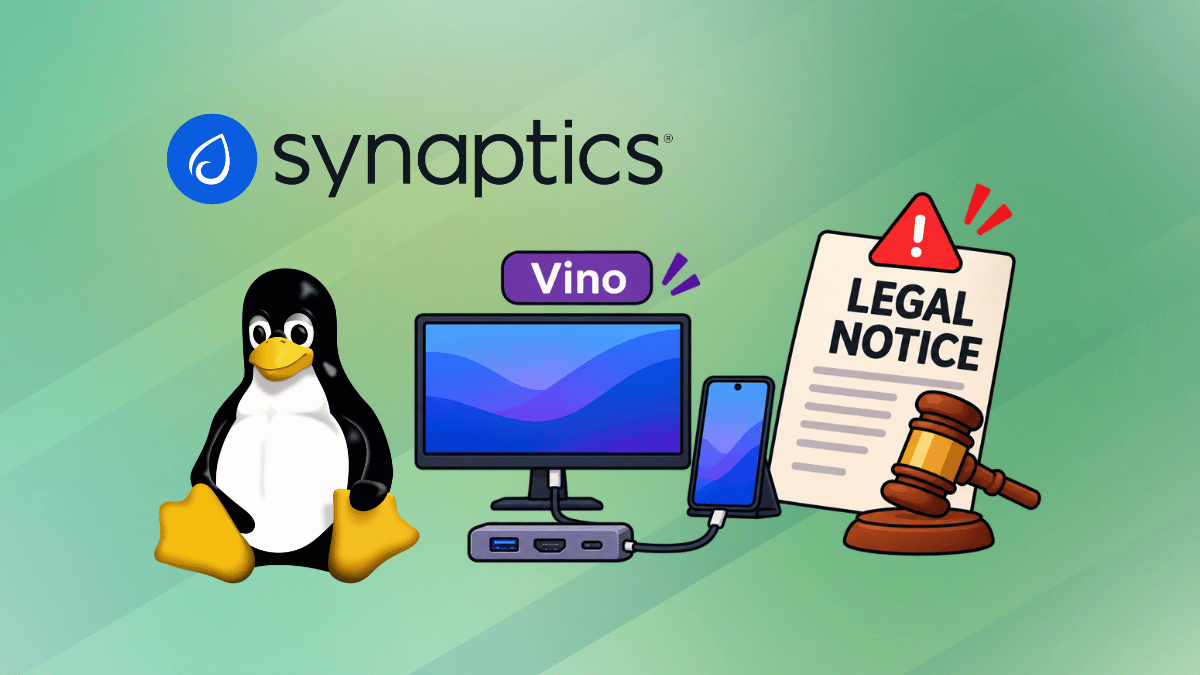
Before we dive into the matter, you first have to understand what DisplayLink is. It is a proprietary graphics transport technology that lets computers connect to one or more external displays over USB, using docks or adapters built around DisplayLink chips.
It works by compressing display data on the host computer and sending it to a chip in the connected device. The chip then decodes it for output to monitors through interfaces such as HDMI or DisplayPort.
On Linux, this support can rub some people the wrong way due to its closed-source nature. That is where Mike Lothian’s (FireBurn) Vino comes in as an open alternative.
Unfortunately, Synaptics owns DisplayLink and has sent Mike cease-and-desist letters alleging that he infringed its DisplayLink patents with his project.
What’s Vino?
Vino is a driver that lets the Linux kernel talk to DisplayLink docks directly. It is meant to replace DisplayLink’s closed-source software and the open source EVDI kernel module that sits beside it.
Mike wrote it with help from Claude Code, and the first version reached the kernel mailing list in June, unfinished. He had faced a communication issue between the dock and the driver and asked other developers for help.
In early July (courtesy of LWN.net), he emailed a Synaptics employee for guidance and mentioned his Rust rewrite of EVDI. About two weeks later, a different employee replied.
That reply said his Rust rewrite of EVDI was not a thing of concern. Rather, the concern was the DisplayLink protocol and codec, which Synaptics believes are covered by its patents. Lawyers get involved
A cease-and-desist letter followed on August 17. It told Mike to stop development and withdraw anything he had submitted to maintainers and hosting sites, with a signed confirmation due by August 28.
An appendix listed over 125 patents without saying which applied. Mike posted a working version 3 of Vino on August 26 and asked Synaptics the next day which claims they had in mind.
The answer came in October as claim charts. They map one claim from each of two patents, GB2484736 and GB2485613, to his source code.
The October 5 letter said Synaptics would seek $25,000 for the cost of preparing those charts if Mike missed an October 11 deadline, with the figure rising by at least $25,000 each week.
Mike replied on October 6 (message 8) with an offer to pause public work on the encoding code the charts point to if Synaptics paused the deadline and the weekly charge. He also asked about licensing that code for non-commercial use.
On October 7, Synaptics said it would grant no patent license or promise not to sue and set October 18 as a final deadline.
 What I can see so far is a very aggressive patent infringement witch hunt against a lone open source developer who was quite open to communication.

 Synaptics took about three weeks to answer his request for specifics, then followed with a potentially life-ruining $25,000 demand that compounds weekly.
Clean room design quirks
Mike describes Vino as a clean-room driver and says he reverse engineered it from captured USB traffic and vendor programs.
If you didn’t know, in a clean-room recreation, one party studies the original implementation, then writes a description, and a separate party builds the new code from that description alone.
It is meant to act as a defense against copyright claims because it shows nothing was copied. Synaptics’ July reply argues that clean-room or independently written code can still infringe a patent.
The timing
Vino also lands in a busy stretch for AI-assisted reverse engineering, from smart TV cleanups to office suite clones. Legal pressure has reached other AI-built projects too.
Mike has already taken down the Vino repository in response to the demands, and Synaptics has not made a public statement so far.
Only time will tell what happens to the work, and I hope someone forked it before it went offline, as that would give others a good starting point to build on.
That truly sucks.
Not in the least bit because displaylink is used in many docks, all of which are barely usable in Linux because the driver support is non existent. If anything, this could BOOST their sales.
Secondly, I really feel like that AI stamp was just added to the title for clickbait. It didn’t matter in the slightest for the issue at hand: Company threatens to ruin developer for fixing their own shit.
Exactly, the real issue is that they claim that people aren’t allowed to make clean room implementations of software that works with their hardware.
This is a really interesting story. “Clean room” implementations might clear copyright, but copyright and patents are two different things. Apparently, the developer is challenging the scope of the patents as what they cover is common domain (they just tweak out how some of it works) (https://tech.yahoo.com/ai/claude/articles/synaptics-sends-cease-desist-order-110000800.html).
DisplayLink have always been touchy about their IP and the lack of open source drivers is the main reason I don’t consider their hardware anymore. I guess they want to stop it getting merged so they don’t end up in a patent battle with OIN.
Sorry what’s OIN?
Open Innovation Network is a patent pool to protect open source projects from patent trolls. It’s basically mutually assured destruction if the pool has any patents covering products you sell.
This is an incredibly bad idea on his part. Patents and copyright are not the same thing. It doesn’t matter at all if he genuinely reverse engineered it, if it violates their patent they have every right to sue him, and they’ll win. Claiming it’s a witch hunt also doesn’t matter. The court is not sympathetic to lone devs violating patents.
It used to be we could protect software with both copyrights and patents, because it was really hard to duplicate a large project. Now, with AI able to shit out a somewhat working implementation in a few days, we only have patents.
And software patents are a terrible idea, that should never exist.
They are certainly abused, but without them, there’s literally no protection from a big company stealing an entrepreneur’s idea and undercutting them. (Like what Facebook did to Snapchat.)
They should be reformed, but I think providing protections to inventors is not inherently a bad idea.
I am speaking as an inventor who has been issued a software patent, so take what you will from that. I’m happy that my idea can’t just be stolen by Google or Microsoft. (Or some slop slinger, for that matter.)
oh no the poor entrepenuer! Not. All software should be FOSS anyway.
Fun fact: I get to write open source software because proprietary software pays the bills.
While yes, I agree that software should be FOSS. I also think that people who invent something should get the freedom to choose if they want to make it FOSS or proprietary. They should get the option to make a business off of it or to just make it free. Nobody should be forced to do either and they should make the decision on their own.
I disagree fundamentally. Just because you came up with an idea first does not mean you should be the sole person able to use said idea. All this does is hamper the progress of civilization. You are under no obligation to tell others how you did something, but if they also figure out how to do it then the law should not shield you from competition and people making your thing cheaper. This is especially true in the case of software where its infinitely copyable at near 0 cost.
I’ve made things before. I’ve never tried to make a profit off of those things. Despite being broke myself. Because I see it as simply extortion to withhold something in exchange for money. The only way I’d ever monetize something digital is to give it out for free and ask for donations if people feel like it and it helps them. Something physical is slightly different as it costs money to make more of them, but I still disagree with the idea that you’d be able to ban others from using a technology just because you happened to patent it first.
Do you realize how much work it takes to make that infinitely copyable software though? Like, yes, it would be super awesome if all software was open source, but if it were, I would probably be working in finance instead.
You see it as extortion to withhold something for money? So all labor should be free? Everything should be free? I should be able to just go set up shop in the Empire State Building like I own the place? Or, is that one of those slightly different things? Maybe just the labor of the construction workers should have been free.
You’re a big fan of monopolies, aren’t you?
I only disagreed with forcing all software to be open source. I believe that while copyrighting your code is fine, I agree with you on the patenting thing. You shouldn’t be able to patent software and sue anyone if they reverse engineer it. I do agree with you on this part. However, yes you should be able to have the freedom to choose if you want to do the right thing, make it open source, or the wrong thing, make it proprietary. Yes keeping this freedom slows innovation. It also gives people who make an idea more of a choice rather than being forced to do one thing. You shouldn’t be able to sue anyone who figures out how your software works though because it isn’t going to be the same code that you made.
Well yes, but proprietary only works with patents. All it means without them is you have to decompile it and reverse engineer it. Which is pretty easy to do these days.
But I’d push back on the idea of “The same code you made” being special. Code is just language and math put together. Take a sentence. “Hi, how are you?” under patent rules once someone patents that specific way to say this nobody else can do it. You can do the same function but have to phrase it differently. Like “Hello, are you well?” and eventually this just gets silly. Being the first to do something the most obvious way to do it shouldn’t give you a right to not let anyone else do it that way.
My argument is based on a fundamentally different way of viewing invention. Many people think of it as a singular inventor/genius coming up with an idea nobody had before, and then anyone else who has the same idea after them is “stealing” it. This is just silly imo. That inventor is not special.
Inventions do not happen because someone has a special idea. They happen because the material conditions exist to make them possible. You wouldn’t invent the car before the steam engine for example. Or the book before paper. Take Calculus. Isaac Newton and Gottfried Wilhelm Leibniz were getting to the same conclusion (inventing calculus) around the same time entirely independently. Because it just so happened they were alive at the right time to do so.
In general inventions will arise some time after the conditions to create them exist. This relies on the work of all human civilization prior, and so these inventions should be the collective property of all humanity.
If one accepts the premise that discovery is an inevitable result of material conditions, the moral and economic justification for patents collapses. In this framework, the patent holder isn’t being rewarded for creating something that otherwise wouldn’t exist; they are being rewarded for being the first to reach a finish line that many others were already approaching. The patent then functions as a tool to capture a monopoly over a natural progression of knowledge, effectively taxing society for a discovery that would have happened regardless.
I’m not really trying to argue with you here btw. Just explaining my complete view on the topic. I get that you might agree with some of this, and disagree with some. I just wanted you to have a full picture of where I’m coming from.
This reads like it was written by an AI.
I don’t know how I feel about this to be honest. I probably would have never heard about it otherwise, since reaserching and writing takes time and humans seem to have less and less free time. There’s also very little money for this kind of journalism these days, so it’s not easy to get paid to do this. On the other hand, I suspect our writing patterns are going to start to shift pretty significantly over the next few years.
Some examples that stood out to me:
The answer came in October as claim charts
Specifically the “came in” clause. I’ve seen that a ton over the past year, but don’t recall this phrase before then.
That is where Mike Lothian’s (FireBurn) Vino comes in as an open alternative.
Another “came in” like clause, but I also find it interesting that open alternative is placed so far away from the noun. Something like “Mike Lothian developed FireBurn as an open alternative”
On October 7, Synaptics said it would grant no patent license
Convention would move the negative before grant (e.g., Synaptics said it would not grant a patent license).
To me, all of the quotes in question just read as especially formal journalistic English. Especially that last one ‘Synaptics said it would grant no patent license’ is just a more formal phrasing that is pretty standard for e.g. newspaper writing, especially if you look at how the sentence structure puts the date first, then the quoted party, then the paraphrase of what they said. Very normal newspaper style.
I haven’t read the article yet but these quotes you pulled out in particular don’t read as AI to me, as a software engineer who talks to Claude all day for work.
Will update once I’ve read the article.
Edit: Yeah, no, this doesn’t read like AI to me at all. AI fluffs up its sentences and paragraphs with excessive detail, this article has a lot of barebones sentences that are clear and to the point. When you try to get AI to write like that it tends to leave out too much context to the point that it becomes confusing. The author appears to be Indian. Are you sure you’re not just misreading the different conventions of Indian English as being AI?
as a software engineer who talks to Claude all day for work
I’m in the same type of job, but I find myself writing a decent amount of documentation for human consumption these days in addition to generating code. That’s part of the reason why I am somewhat tuned into this, but I could also be way off my rocker.
A lot of the documentation I write is transcribed from voice (using the whisper engine so bare that in mind) and I find myself talking like that without AI scrubbing it. I guess it sounds more professional in my head. Honestly though, I don’t really get a lot of human interaction, so that could definitely be part of it.
¯\_(ツ)_/¯
Times makes fools of us all. I definitely could be wrong.
The idiom “Came in” has been in common use since the last 1800’s. You can find it on Google’s N-Gram search. Heck it appears in Shakespeare!
Agreed. The “came in” is popping up more and more. I’m guessing it’s watermarking since it doesn’t make any sense at all usually.