

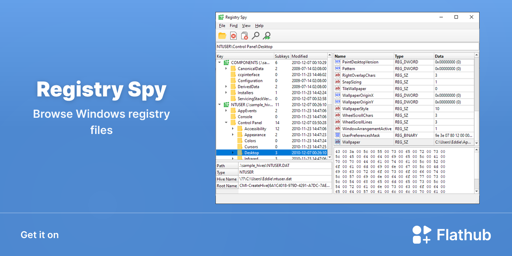
What are we supposed to do with it?
You must log in or register to comment.
I used a win2k reg editor in wine years back to do nondestructive forensics on a windows partition.
I’ve used a registry editor on Linux before to pull the Bluetooth pairing keys off my Windows partition so I could add them to my Linux Bluetooth config so the Bluetooth device would work on both systems.
Nice one.
Could you please explain a bit, do you mean that otherwise your bluetooth device would not auto-connect to both devices?
I mean, you probably can’t use them simultaneously anyway?
They said windows partition so I’m assuming they mean when they boot into Linux the Bluetooth device just works instead of needing to redo the pairing process.
you probably can’t use them simultaneously anyway?
You can, BT >5.0 supports up to 2 simultaneous devices.
I think they meant that they copied the keys from Windows to Linux so that they can easily pair their Bluetooth device without having to repair when booting into the other OS.
https://wiki.archlinux.org/title/Bluetooth#Dual_boot_pairing
So without doing it, I think you have to forget and repair every time you want to connect your Bluetooth device if it was paired with the other OS. If keys are copied, you can just connect it without hassle. I did it so that I can pair my controller by just pressing its Power button, and it does not worry about whether my computer is running Linux or Windows.
Trying to edit offline registries in WinRE is a pain in the ass, assuming this does that it’d be a godsend
Editing *.regs to be used in either your Windows partitions/VMs or Wine prefixes.
Fix the registry of your friends and family of course!
Also, probably for wine/proton/umu since they use registry files as well.
I guess for WINE and Proton maybe.
If you use Windows, you can install that software to browse your registry. If you have already set up Flatpak via WSL or whatever, I can imagine that being a decent option.
But why would anyone do that? The application has native support for Windows too.
Sometimes you need to take a look at a hive from a Linux machine.
manifest destiny on the windows front


