

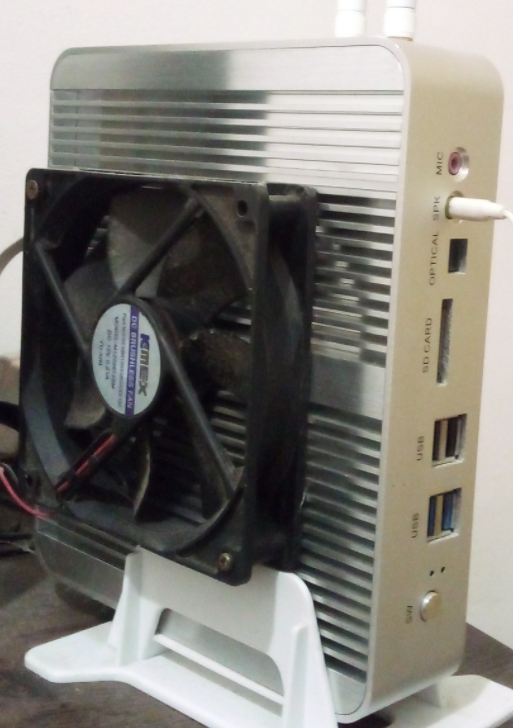
I got a pc that suffers from severe heating problems because of its poorly designed passive cooling case. I tried several strategies to put temperature under control, did a lot of tests with thermald, but ended up hacking a fan into the case. However, I still have problems with ssd temperatures.
Right now, as I write this, the nvme ssd is at 67ºC and easily goes beyond 80 or 90 during data transfers. I already lost 2 ssds before realizing this was the problem, because I was controlling just the cpu temperature.
There’s no physical way to force airflow where the ssd is, so I was wondering if there’s some way to throttle data transfer of something to prevent the ssd temperatures from reaching a threshold. All I could find was a vibecoded github repository. I don’t care if data transfer gets ridiculously slow, as long as the ssd remain safe, and I can’t consider getting any new hardware right now.
I’m currently running fedora 44 on that machine
Edit: I thought there was an easier software mitigation to that, but apparently, solutions will tend to the hardware side, so here are the hardware details:
- It’s an unbranded chinese cheap mini pc with a heat dissipation case that doesn’t dissipate well
- The ssd is mounted on the back of the motherboard. The model is a sandisk M.2 1TB 2280
Here’s a photo of the case, for the reference (don’t judge me lol):
I’m gonna start off with an apology because my flippant tone may have made it seem like I was targeting you when really I’m running on all eight cylinders trying to blast out accurate, useful posts that are fun to read. I’m sorry I hit you with a little friendly fire, that wasn’t my intent.
Working backwards: ca glue doesn’t make a chemical bond with the plastic of a semiconductor package, it creates a solid material out of itself using water that relies on the surface dressing of the stuff it’s being used on for mechanical purchase. That’s why you gotta use sandpaper to rough up stuff you’re trying to glue together first. That also explains why supergluing a nut to an ic doesn’t hold like you’d think it would and in the case of for example the big boy fets and voltage regulators of a video card creates a weaker bond than the solder to the pcb (I was carrying a mining gpu by the bolt glued to the vrm and the glue failed and the card dropped three feet onto concrete).
Removal of ca glue can be easily accomplished with acetone. Be careful using acetone on or around electronics because it will eat certain plastics (the “a” in ca glue stands for acrylic!).
What you do need to be careful with when using ca glue is natural fibers. For reasons I have never felt (see what I did there?) the need to investigate, it reacts with them and can get really hot.
I’m gonna combine the other two sections of what you wrote into one because there’s a misconception there.
Based on the ops own post, the ssd is idling at 67 or so c. We wanna keep it below 90 for [explanation redacted].
That doesn’t mean there is 67c air inside the pc case. That would be crazy. It means the ssd can’t effectively dissipate its heat into the surrounding air at idle until it reaches 67c.
The equation for that is (kATd)/l.
K is the ability for the material to conduct heat, A is the area over which it’s happening, Td is the difference in temperature and it’s all over l, the distance it’s happening across.
Basically every part of that equation is bad numbers when we’re using a bare die into the ambient air.
But why?
Well straight off the bat, air sucks. Heating it up is way harder than heating up for example plastic, water, oil, metal or human skin. That’s why when you run out of heating oil for the furnace and use the coil stove burner to heat the house you can keep your hands cozy by rubbing them over it but get a crazy burn when you put them on the coil. Air is such a bad conductor of heat that the difference between “ahh” and “AUGH!” Is a couple of inches.
But plastics suck too! Remember that the part of the ssd that gets hot is the big ol chip and the part of the chip that gets hot is the silicon die inside it. Plastics are in general so bad at conducting heat that in many cases we use them explicitly for that purpose in industrial engineering. If you’re worried that some parts variable temperature will have an effect on some other part then you can plop a chunk of nylon or something down in between em and suddenly the temperature shifts are good enough for government work!
So the ssd is getting too hot before it can transfer its heat to something else (the air). It’s being hampered by how shitty the two materials plastic and air involved are at doing this job but that isnt the whole story! We havent even talked about surface area or thermal mass!
The chip could effectively conduct away more of its heat if it were bigger. If you have a one inch square chip it can only radiate (I’m playing fast and loose with the words here but all throughout this post I’m actually only talking about conduction, the amount of joules lost to terahertz radiation in a ssd chip is negligible) into the air close to the surface of the 1 square inch chip. If it were three square inches it would be able to heat up three times more air! A heatsink will usually have a knurled surface with fins and other hard to dust features that raise its surface area super high. It’s not uncommon to see a little bitty heatsink with an effective surface area of a foot square!
We can also solve for bigger in a different direction, and imagine a chip with a one inch cubed package size as opposed to one inch square. Now not only do you get to take advantage of the 5x increase in surface area, but you have much more mass to mess with. If it takes one joule of energy generated in the ssd chip die as it recalls futa SpongeBob memes to heat up the normal 1 inch square package surface one degree, the one inch cubed package can take much more bikini bottom dick pics before it heats up one degree. Because it’s bigger. See what I did there? Futa, bigger? Never mind.
That’s called thermal mass.
Oh yeah and I guess in a heatsink there’s usually some kind of conductive material to make a good connection between the package and the heatsink surface. I didn’t talk about that but I’m running out of energy so just imagine a good explanation of why even something not specifically engineered to do the job like ptm is still better than shitty ol microscopic air pockets.
So to recap: the heat is coming from inside the ssd. We want to get it away from the ssd. We can use a big thermal mass with a huge surface area made out of a material that conducts heat really well coupled to the die with some solid or liquid to both reduce the effect a joule of heat generated has on the die temperature and increase the rate at which that heat is conducted into the air.
Adding a heatsink improves literally every part of the math for getting parts cool and if that doesn’t convince you I encourage you to experiment on your own with your hair dryer and see what happens.
E: I didn’t even talk about the duty cycle of the chip getting hot. Unlike your computer cpu which even in a real low pee state still does something, an idle ssd controller is pretty much off (they still fiddle fuck around with blocks and do other dumb shit but they’re consuming less energy than an idling cpu and therefore need to dissipate less heat. The point stands.). It’s only under some load that heat gets generated and needs to be dissipated.
So if you’re just looking through your futa SpongeBob memes folder and having a chuckle the spikes of load are probably not enough to even heat up the heatsink appreciably while transferring your friends usbc futa SpongeBob memes folder on to your ssd would result in the need to rely on the thermal mass of the heatsink and its big surface area and its much better ability to transfer heat into itself from the chip and from itself into the air.
Jeebus that’s one heckuva wall of text. I skimmed:
When it comes to the broader “superglue” you mentioned, I’ve used several that create a bond by melting the surfaces it’s applied to. I get it - you were trying to get across “metal good” and “superglue” just gets across easier. But if you knew the horror stories I’ve seen in the process of helping thousands of newbies troubleshoot hardware issues, you wouldn’t be so flippant about your instructions.
OP’s ssd that should be idling in the 40C range is idling at 67C. Do you think addressing just the ssd temps with a heatsink will solve OP’s issue or is there some core problem that needs to be addressed before we even start talking about ssd load temps? With 3 ssd failures so far and unaddressed heat issues in other components reported by OP, how long do you think OP’s motherboard, PSU or other components are going to last?
Superglue is ca glue. Ca glue chemically bonds to itself and mechanically bonds to the surfaces it’s put between. I would like to know the kind of glue you are talking about. I never instructed the op to glue a nut to their ssd, however that would be a fine thing to do.
If it’s not clear by now: yes, I believe the problems will be resolved with a heatsink. They asked about how to stop losing ssds in an environment with passive cooling and the answer is a heatsink. Even if I didn’t have a wealth of theoretical knowledge that can simply be regurgitated while on the toilet to people who will not read it, I also have experience dealing with flash memory in sealed, passively cooled and high vibration environments which indicates that conclusion.
Here’s how a heatsink will resolve their problems: the heatsinks huge increase to their nand chips thermal mass will reduce the effect that periodic reads and writes have on its die temperature and the heatsinks much greater surface area and better transfer properties will dump that heat into the ambient air much faster than the surface of their nand chips package will.
Their pc has vents and is designed to rely on passive cooling. Perhaps it will last a long time, perhaps not. Pulling the ol “would that end racism? Would that end sexism?” Is akin in this instance to rushing into the operating theater to disrupt an in progress remediation of gunshot trauma to inform the staff that the persons heart disease is a big deal.
And how’s that going considering 3 ssd failures and current idle temp of 67C versus the expected 40’s? You’re clearly not so dumb that you don’t know that a heatspreader will have its limits when you’re up against dead air so this is plainly what’s called being wilfully obtuse. And OP is the one who will suffer for it.
Funny, I’d liken your advice to putting a bandaid on a gunshot wound. But keep telling yourself you’re a trauma surgeon and not the janitor in a lab coat that OP was unfortunate enough to stumble into. Learn to admit when you’re wrong.
Based on what we know about the pc it’s going fine. The pc is still running. Were asked about how to fix a problem with an ssd.
You seem real bent out of shape about this. It’s not a big deal. The op got lots of advice and input, I sent them two links to heatsinks that will most likely fit just fine. Why not just wait and see how things turn out? There’s no need to continue to be insulting and confrontational.
Dumbass.
The knowledge and experience to reliably predict how this will end and empathy for anyone who has to deal with a PC sudden (or more likely slow and bizarre) death event.
Okay dumbass.
There is no reason to be aggressive, insulting and confrontational the way you are.
If you can’t make your point without resorting to personal attacks then consider not replying until you’re cooled off.
It’s pretty clear from what I said that I’m referring to the pc still running fine while multiple ssds have died.
From what I can tell the other components the op references are: the WiFi module. Unfortunately radio baseband chips were well into their implementation without any kind of heat mitigation era when this pc was manufactured. That’s another part that could likely benefit from sticking a heatsink on, lots of desktop motherboards and even some laptops have some kind of heatsink or pad coupling the radio to the chassis. Probably glue a nut to that too, straighten it right out. Radio is even more duty cycle dependent than ssds due to the nature of ip communication. It’s likely what drove thousands of devices to be designed without any way to deal with the heat from those little things. Why spend five times the cost of the chip sticking a sink on there when it’ll just automatically throttle down to protect itself was probably the engineering calculus.
What does the present +22C leap from expected idle ssd temps signify? How much energy does this take, where is it coming from and how much do you expect it to drop with even a puny 60mm fan circulating air in the area? What does not addressing this signify for overall system lifespan?
It doesn’t take much experience to get these answers right (which you have loads of!!!) but it does take skill to be this wilfully dense. Which puts you among that one group of people you always find in any newbie-oriented hardware forum, people who offer bad but seemingly well-meaning advice, but are well-meeaning only up to the point where they have to admit they are wrong at which point they do what you’re doing and double down for ego’s sake. This deserves ire.
FYI when a real trauma surgeon hears “heart problem”, they’re thinking beta blockers, blood thinners and vasodilators - you know, the stuff most cardiac patients take that would cause you to bleed out on the operating table without special precautions. An ironic demonstration of your inability to scratch beyond the surface of any given topic. I bet you don’t even clean the toilets properly.
It signifies that the ssd is in a passively cooled case without a heatsink.
I’d say adding a heatsink to the ssd will drop the idle temperatures down at least ten degrees (more like fifteen or twenty, but it’s important to not overestimate no matter how optimistic someone might be!). During long transfers is where the real benefit comes in, it’s still possible to get the ssd in the 90c zone but it’s gonna take much, much longer because the package will take forever to heat the heatsink up and the heatsink will much more efficiently dump that heat into the air. That flatter curve is gonna be a huge help to the op because most people aren’t running constant data transfers as fast as their equipment can handle them 24/7, 365. It’s likely op is seeing ssds die when they transfer their 200gb futa SpongeBob memes folder and the temperature spikes up into the 90s for a few minutes, not while serving that folder to all their fellow bikini bottom enthusiasts at the 10gbps lan party. A flatter curve keeps the ssd at a safe temperature longer.
It’s possible that the ops combination of pcie version and usbc revision (it’s a 7th or 8th gen intel iirc) can’t even do enough operations to get the heatsinked ssd up into the water messes up your packages seal zone when making transfers onto or off of it. Internal action will still heat it up as fast as possible though because the snappy ssd controller won’t be checking its watch and tapping its foot while some packet takes precious microseconds to come down the bus.
The computer has been fine. It will probably continue to be fine once the op gets a heatsink on their ssd. They did not ask us to help them price out and build a new computer, but to keep their ssds from dying, and not to repeat myself too much but that’s what a heatsink will do.
Now it’s also possible that their power supply is whats periodically killing their disks but the heat is a good first step.
You really gotta ease up. Insults and rudeness couched in flowery language are no shield. If this is your first time on lemmy, people take that kind of stuff much more serious than on Reddit.
There’s uh, also a pretty flagrant degree of classism in your replies that might not go over well on the left wing servers like ml. Just be aware.