

- cross-posted to:
- pcgaming@lemmy.ca
- cross-posted to:
- pcgaming@lemmy.ca
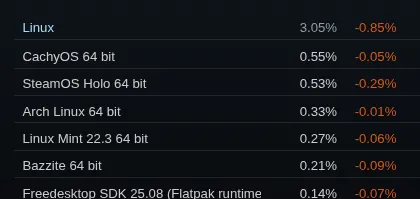
Steam on Linux use in March hit an all-time high of around 5.33% marketshare. Since then it pulled back to around 4% while for September 2026 the Steam Survey results are now in and it’s clocking in just above 3%.
The Steam Survey results for September that were published this evening indicate a rather steep decline of 0.85%, down to 3.05%. Meanwhile macOS is at 1.92% and Microsoft Windows at 95%.
As with most months where Steam Survey indicates an abnormally large decline for Linux use, the second stop is checking on the language use… Once again a case of a big spike in Simplified Chinese use. Steam’s Survey reports a 7.42% increase in Chinese use, up to 31.39% overall of the Steam population. Usually with those large month-over-month swings where Steam China use shoots up dramatically is a boost to Windows and a detriment to Linux. Some attribute the large increases in Simplified Chinese use to being a reporting/sampling issue.
When diving into the Steam Linux data exclusively, CachyOS has spiked by another 2.65% to now account for 18.12% of the sampled Linux gaming population. That even outperforms SteamOS Holo coming in at 17.37%.
Among Linux gamers on Steam, AMD CPUs still account for the high 60 percentage space thanks to the Steam Deck and Steam Machine using AMD APUs and their open-source/Linux support being popular with enthusiasts.
Those wanting to dive in to all the Steam Survey stats for September can find the fresh data on SteamPowered.com.
I wonder what the sampling/reporting issue is? Why Chinese specifically? Are there droves of Chinese gamers flip-flopping between Linux and Windows? That doesn’t seem likely.
I think it’s that Chinese gamers are much more likely to use Windows and that sampling is random so whenever too many Chinese computers are selected on sampling the Linux share decreases