

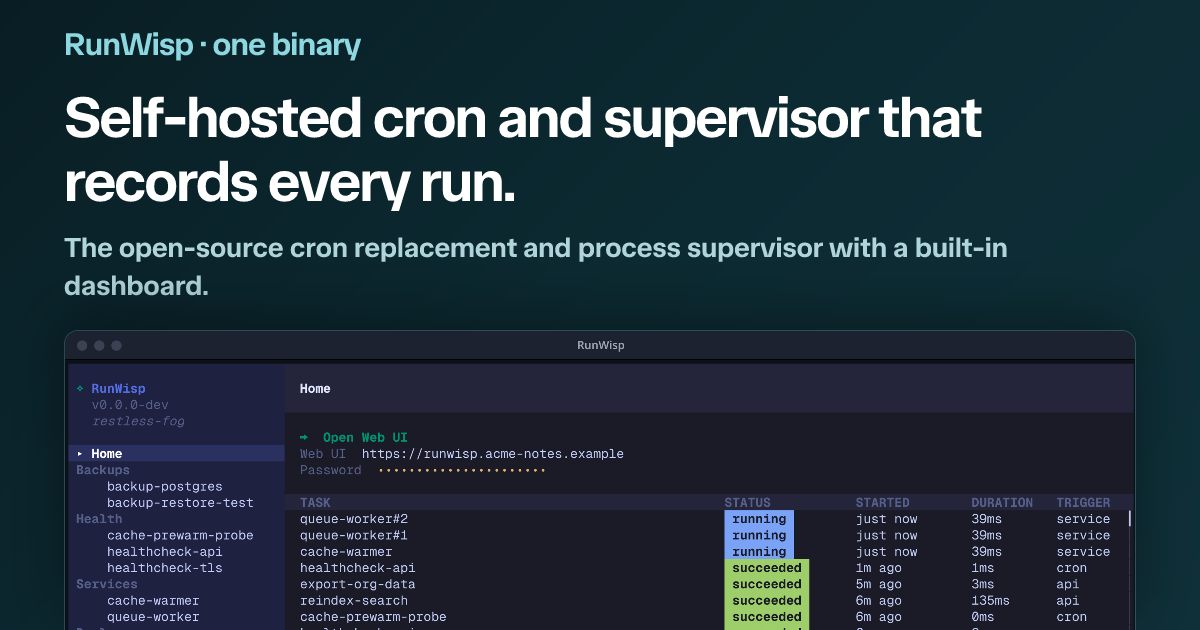
I created a tool that’s easy to set up and gives you fast and beautiful web UI and TUI from a single Go binary.
It can serve both as a cron replacement, or just as a cron supplement - let’s say, to version control your cron tasks in a small team. It also has an alert system that allows you to send slack/discord/telegram/email when something bad happens.
I want your feedback. You can help me shape this product into something people will find pleasant to use.
This daemon is copyleft GPL-3.0-or-later - completely free to use.
RunWisp is currently in pre-release phase but is slowly approaching its v1.0 stable release.
Website: https://runwisp.com/
GitHub repo: https://github.com/runwisp/runwisp - feel free to open an issue!
Quick start: https://docs.runwisp.com/getting-started/quick-start/
AI Disclosure
- Design - Hint
- Implementation - Pair
- Testing - Assisted
- Documentation - Pair
- Review - Hint
I generally like some things that syatemd gives, but is there an easier way to create timed automations with systemd timers?
with cron, its just a single line with the recurrence pattern and the command. with systemd, you have to create a timer unit file with several lines, a service unit file with several lines, put them in the right directory, reload systemd, enable the timer. timers are not difficult, but much more convoluted than the crontab. if you have to make multiple pairs, or update something in them, it gets old fast.
here’s a single line for you which creates a one-shot service+timer in one go, suspending the system in 4 hours:
systemd-run --on-active=4h --unit=suspend-after-4h /usr/bin/systemctl suspendIf you want it to run repeatedly, simply replace
--on-activewith--on-calendar="*-*-* 04:00:00"for example.