

cross-posted from: https://lemmy.ml/post/44022276
Jolla may not be a household name, but for more than a decade the Finnish company has positioned its Linux-based Sailfish OS as an alternative to the mobile software duopoly that is Google’s Android and Apple’s iOS.
Now, 13 years since it tried to cut through the market with the Jolla Phone—a device which remarkably received software updates through 2020—it’s back with a successor of the same name.
This time, the company is positioning its handset as the “European phone.” This bit of marketing caters to the growing distrust in US digital services and platforms that has arisen since Big Tech sidled up to the second Trump administration.
The new Jolla Phone (pronounced “Yolla”) costs €649, mimics the Scandinavian design of the original, and has secured more than 10,000 preorders since its preview in December 2025. Those orders are expected to begin shipping at the end of June. At Mobile World Congress 2026 in Barcelona this week, the company divulged more details about the phone’s hardware.
Alt Android
Jolla has had a turbulent history. After the company floundered the launch of its Jolla Tablet in 2015, it nearly went bankrupt and pivoted to licensing Sailfish OS to automotive companies and governments, including Russia. After the invasion of Ukraine, Jolla had to cut ties with Russia, and a corporate restructuring meant that Jolla’s assets were acquired by the company’s former management under a new company called Jollyboys.
It got back into the smartphone game in 2024 with the Jolla C2 Community Phone, made in collaboration with a local Turkish company, and it was this experience that gave Jolla the courage to jump back into the hardware business with the new Jolla Phone. Unlike the C2, this device is completely assembled in Salo, Finland, where Nokia phones were manufactured more than a decade ago.
“Europeans want more European technology,” Sami Pienimäki, CEO of Jolla Mobile, tells WIRED. “People want to go away from Big Tech, and the other trend is that European people want sovereign tech—it makes it possible for our kind of company to have a position in the market.”
Building a smartphone from scratch was also much harder over a decade ago, but today, Pienimäki says the operation can be fairly lean without having to “pay too much up-front.”
The components are sourced from various vendors and countries. The MediaTek Dimensity 7100 5G chip hails from Taiwan; the 50-megapixel main and 13-megapixel ultrawide camera sensors are from Sony; the 8 or 12 GB of RAM is from SK Hynix in South Korea.
“There are Chinese components as well—we are totally open about it—but the key is that, as we compile the software ourselves and install it in Finland, we protect the integrity of the product,” Pienimäki says.
What makes Sailfish OS unique over competitors like GrapheneOS and e/OS is that it’s not based on the Android Open Source Project, but Linux. That means it has no ties to Google—no need for the company to “deGoogle” the software; meaning there’s a greater sense of sovereignty over the software (and now the hardware). Still, it’s able to run Android apps, though the implementation isn’t perfect. Another common criticism is that it’s not as secure as options like GrapheneOS, where every app is sandboxed.
There’s a good chance some Android apps on Sailfish OS will run into issues, which is why in the startup wizard the phone will ask if you want to install services like MicroG—open source software that can run Google services on devices that don’t have the Google Play Store, making it an easier on-ramp for folks coming from traditional smartphones without a technical background. You don’t even need to create a Sailfish OS account to use the Jolla Phone.
Jolla’s effort is hardly the first to push the anti–Big Tech narrative. A wave of other hardware and software companies offer a deGoogled experience, whether that’s Murena from France and its e/OS privacy-friendly operating system or the Canadian GrapheneOS, which just announced a partnership with Motorola. At CES earlier this year, the Swiss company Punkt also teamed up with ApostrophyOS to deploy its software on the new MC03 smartphone. Jolla is following a broader European trend of reducing reliance on US companies, like how French officials ditched Zoom for French-made video conference software earlier this year.
Murena CEO and founder Gaël Duval wrote in a statement emailed to WIRED that the company believes it has a different mission from the Jolla Phone as it’s trying to bring the existing mobile app ecosystem—minus the permanent data collection by Google and third-party trackers—without a learning curve for the average person. “We want to make privacy possible for the everyday person without the need for technical expertise or a development background,” he says.
The Phone
A common problem with these niche smartphones is that they inevitably end up costing a lot of money for the specs. Take the Light Phone III, for example, a fairly low-tech anti-smartphone that doesn’t enjoy the benefits of economies of scale, resulting in an outlandish $699 price. The Jolla Phone is in a similar boat, though the specs-to-value ratio is a little more respectable.
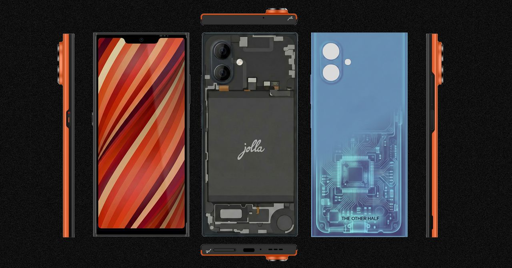
It’s powered by a midrange MediaTek Dimensity 7100 5G chip with 8 GB of RAM, 256 GB of storage, plus a microSD card slot and dual-SIM tray. There’s a 6.36-inch 1080p AMOLED screen, the two main cameras, and a 32-megapixel selfie shooter. The 5,500-mAh battery cell is fairly large considering the phone’s size, though the phone’s connectivity is a little dated, stuck with Wi-Fi 6 and Bluetooth 5.4.
Uniquely, the Jolla Phone brings back “The Other Half” functional rear covers from the original. These swappable back covers have pogo pins that interface with the phone, allowing people to create unique accessories like a second display on the back of the phone or even a keyboard attachment. There’s an Innovation Program where the community can cocreate functional covers together and 3D-print them. And yes, a removable rear cover means the Jolla Phone’s battery is user-replaceable.
Pienimäki says that while the device doesn’t have FCC approval, you can theoretically import it into the US, and it should work with the major US carriers, though compatibility is rarely a given. Jolla is considering a separate US launch, though right now it’s focusing on the European Union, the UK, Norway, and Switzerland.
Antti Saarnio, Jolla Group’s chairperson, reiterates that the Jolla Phone will be a niche product. “Most of the people using Android or iOS will not switch, but we should treat this as a stepping stone for something new,” Saarnio says. The “path to real volume” will come from the mobile market breaking down into new form factors, powered by artificial intelligence.
He’s likely referring to Jolla’s Mind2, a privacy-focused AI computer, which is still in active development. It plugs into a PC and connects Jolla’s AI assistant to apps like email and calendar locally—no cloud access required. The chatbot-like interface lets you ask it questions about your data, whether you’re fishing for something from an email or a private message. While the new Jolla Phone won’t have any AI capabilities at launch, Saarnio says an integration will be an option users can enable later this year.
Jolla has street cred for supporting its devices for a long time, but we’ll have to wait and see how the fresh hardware holds up and just how much the company has polished the Sailfish OS experience, especially since it’s much easier today to get started with a deGoogled Android alternative.
The license is a one time payment for third party models. All of them are already aging. The C2 was a white label phone for Sailfish OS, the first dedicated Sailfish OS device in years and does not require any license nor does the new to be launched “Jolla Phone”. Most people ordered the Jolla Phone at 580 EUR. Whatever “postmarketOS-capable” phone you were thinking about but for 58 EUR it can’t be that great. Even cheaper Chinese competition equivalent hardware will cost around 200 EUR. The only Dimensity 7100 device I could find at this point was 260 EUR or so, with a worse screen.
I do agree that they should go fully open source but they are at least gradually opening up those parts that are still closed (mostly UI and some few stock apps). Sailffish OS is light years from mainstream adoption, at the very least. But that is not the game they are playing. This is a niche product for people that either want to get away from Google or Apple, or some that actually like the fairly unique UI of Sailfish OS or like to tinker with its Linux base (whatever you think about Sailfish OS and its not entirely open nature, it is still the most functional Linux based alternative out there, when it comes to functioning as a phone, including VoLTE, camera etc, at least in Europe).
Jolla has been years out of the wheel when it comes to own hardware. The crucial thing they need to prove now is that they are capable of delivering what they announced at maybe 15-20k sales.
a year ago I could get the Poco F1 and Oneplus 6T at those prices. SDM845, 8 GB RAM, fast storage, widely available, fully postmarketOS and mobian supported, some Halium options (Ubuntu Touch) along with LineageOS et al. nowadays even faster ex-flagships can be had in the $50 region. that’s what you get when you wanna experiment and tinker, not 10x that to get the same feature set.
The Pocophone F1 was 300 EUR when it launched. Sure you can buy used phones for much cheaper than new ones. If you want to get a cheap Sailfish OS device, get a used Sony Xperia 10 II for 50-80 EUR. Yes, it is a tad worse in performance for the CPU (and much worse for GPU, in case you care about that) than the F1 but there goes your “10x” difference, when one is not comparing apples and oranges. Or you go for a community supported phone like the Mi Note 10, which you can find for 120 EUR, comparable SOC performance but much better screen and dramatically better camera than the F1.
Btw how is the camera functionality, VoLTE functionality, battery status, etc on such a device with postmarketOS? Honest question, because according to postmarketOS documentation, there is not a single device that is listed to have all the basic functionality, other than the Librem, a device with weak hardware sold today for 799 USD.
Tinkering is not black and white but a spectrum. That is why LFS, Gentoo, Arch, Fedora, Linux Mint etc all have their justification to exist. Sailfish OS gives a a pretty functional phone out of the box but allows you to tinker around if you want to, not to the extend a Postmarket OS would but UI aside, you can get down deep and dirty if you want to, as far as I understand. In a similar way, I don’t think one should get Sailfish OS over postmarketOS, there is a place for both. That Sailfish OS costs you 10 times more, necessarily, is just false information.
The premium of the new Jolla Phone, over Chinese competition is maybe 2-3 fold. New vs New. Look at other dedicated Linux phones and that is quite common, simply because small production run phones can never compete with Chinese mass production phones on price.