

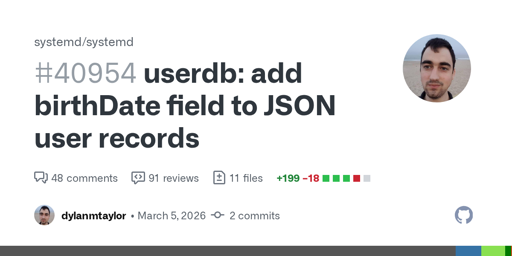
Fork time? Maybe all the anti-systemd zealots were right all along…
Edit: To address whether it is likely that this change will affect users: Gnome is planning a stronger dependence on userdb, the part of systemd where this change is being implemented. https://blogs.gnome.org/adrianvovk/2025/06/10/gnome-systemd-dependencies/
Final Edit: The PR has been merged into main.
Sure, but trying to apply it to the entire world when only a few countries are currently impacted is fishy at best.
And no, we don’t know yet what the entire world will do about it, even if Meta is trying to lobby everyone, there’s also a push for making opensource exempt from it, in that case those applying the PR have worked for nothing.
It depends, if the purpose is age verification then yes I will oppose it.
I didn’t have any so far, for the very simple reason that I don’t have the technical knowledge to judge by myself. This PR tho doesn’t require any tech knowledge to understand what’s going on.
The road to hell is paved with good intentions, even tho by reading the PR thread I’m not sure the intentions behind the push are actually good as you seem to believe.
That’s something I fully agree with.
Let’s hope it succeeds. Actually, let’s hope the law is overturned entirely. And while we’re at it, let’s hope Meta fails, crashes, burns and takes all its bullshit down with it, but that’s only tangentially related.
Then I’ll not tell you what I intend to use that encrypted hash I’m writing to my app’s data storage for.
Any data storage can be abused. This one is transparent about its content, but I don’t see anything implying that you have to enter anything, let alone have to enter your actual birthdate. It can be used for parental controls, it can be used for age restrictions, but if I implement age verification, where I store that data on your machine is the least of your worries.
Where I store your ID on my machine, on the other hand, should be more concerning, and even more so the fact that I need your ID at all.
We can argue whether this is necessary, whether it can serve reasonable use cases (such as voluntary parental controls), but at the end of the day, it’s such a small and exchangeable part of the system that it’s not worth the shit people give systemd over it.
I think controlled, transparent storage is better than intransparent, and any storage is only as evil as the things using it. Target those things instead.
Yes, anything can be abused nowadays, but you can’t cut yourself off technology, unless you want to live as a hermit, I’m pretty sure none of us wants that.
And no, I’ve never given my ID to anyone that’s not my government, and I won’t, if they classify me as a teen because of it, so be it.
Yes, what systemd is currently doing is pretty innocent compared to other things, I believe that’s on purpose so people can easily accept it and they can do worse later. Corporations are behind this, don’t forget that.
That point, I disagree on, because systemd (not) implementing this doesn’t actually make it easier (or harder). Distros that want to comply would just write a file for it somewhere instead. Distros that don’t comply will just not implement any verification process.
What systemd does here is offer a solution to secure it centrally (see the commit discussion about the most efficient and reasonable way to wipe that info from memory again). Considering the whole issue, I think its impact on feasibility of verification is minor, while the advantages of standardisation make it preferable to a wild growth of uncontrolled alternatives.
Another user pointed out the concept of anticipatory obedience to me, and in that context, corporations pre-emptively bowing to authoritarian surveillance is definitely a cowardly move. We agree on that.
Here’s to hoping this entire discussion becomes just as pointless as you expect the PR to become. If that’s what I end up being wrong about, I’ll gladly take the L for cynicism and the W for privacy.
It doesn’t as long as other init systems exist and people can luckily choose, hopefully that will always be the case.
Agree on that, I think that’s the hope for everyone here.
Of course, which is why I said it was “somewhat” central earlier in the thread: it’s not universal, even if systemd is widely used.
Other init systems generally also have ways to store data (not specifically dates, just in general), and some overarching standard for securely accessing them would be useful for intercompatibility, but that’s a mess as it stands anyway.
Also agreed. Just because I personally come down on the systemd side of the debate doesn’t mean everyone should have to use it. Standards are nice, but there always should be alternatives, in case a standard gets captured by twats (which kinda is the debate we’re having: whether systemd has started bowing to fascists significantly enough to warrant migrating away).