

Fork time? Maybe all the anti-systemd zealots were right all along…
Edit: To address whether it is likely that this change will affect users: Gnome is planning a stronger dependence on userdb, the part of systemd where this change is being implemented. https://blogs.gnome.org/adrianvovk/2025/06/10/gnome-systemd-dependencies/
Final Edit: The PR has been merged into main.
@skyline2@lemmy.dbzer0.com @linux@lemmy.ml
Brazilian here. I’m neither a lawyer nor a specialist, just someone who has read the Portuguese text from the Brazilian flavor of the ongoing worldwide age check set of laws.
I must note that the Brazilian age check law (Lei 15.211/2025) specifies “vedada a autodeclaração” (English: “self-declaring is forbidden”). This means that this kind of implementation, where age or birthday is an user input, wouldn’t be compliant to Lei 15.211/2025, because it requires the age information to be assessed independently from the user whose age is being assessed. This means face biometrics, government-issued ID (in our case, CPF, CNH, Passaporte and similar) or “behaviorial analysis”… Anything but a “yes I’m 18” or “I was born in day month year”, for those are self-declared and the Law says it’s “not enough”.
Someone should warn the systemd maintainers of this “Brazilian jabuticaba”.
(Cross posting this reply of mine because the post was cross posted to two different Lemmy instances)
I believe this only stores that information. It’s not a system of declaring an age
@ominouslemon@sh.itjust.works @linux@lemmy.ml
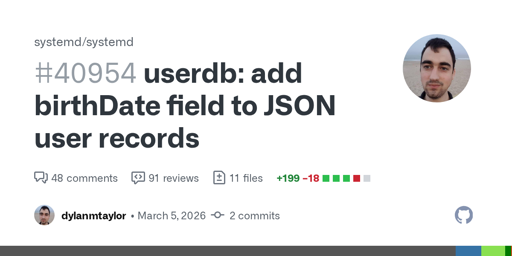
The git PR specifically mentions a
birthDate, a data struct that feels like it could easily be tampered with (therefore, far from “confiável” (trustworthy) as explicitly required by “deverão ser adotados mecanismos confiáveis de verificação de idade” (“trustworthy age checking mechanisms must be adopted”)).Thinking of age checking as some kind of OAuth flow, one would ideally store the authz token from whatever age checking provider validated the user’s age, instead of some plain data which, depending on the provider, wouldn’t even be handed to the application.
I can sort of imagine the following, hypothetical flow:
Some age checking models (such as EU) seems to be doing a similar thing to what I hypothesized above: the EU Digital Wallet returns a token, instead of PII. A token that can be checked against the Digital Wallet API for validity (theoretically) without disclosing who the user is (in practice, it’d be another, pretty reliable piece of traceable data despite any “anonymity”)
I’m not sure whether a similar thing will be implemented here in Brazil (we got an official gov app, gov.br, which can already be used for “social log-in” by 3rd-party platforms, but I don’t know whether it’s ready for age check provisioning).
As far as I know Brazil and Brazilians, it’s highly likely we’d end up with dependencies on Microsoft or Google services because Brazilian gov can’t help but handing its own sovereignty to US tech corps, which adds to the dystopia.
I must make something very clear: I’m far from agreeing with this dystopia, I deeply despise this whole “age check” thing going on worldwide; I’m just thinking as a DevOps would.
Wait until Iran nukes the US and the financial systems collapses. Having bajillions of dollars will not help when dollars are worth nothing.